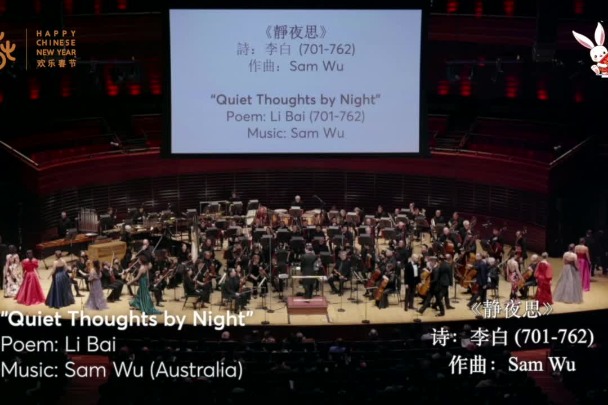
Quiet Thoughts by Night
Overview
Quiet Thoughts by Night is a celebrated poem written by the Chinese poet Li Bai during the Tang Dynasty. Known for his powerful and evocative imagery, Li Bai captures the essence of longing and nostalgia in this succinct yet profound piece.
Poem by Li Bai
Li Bai, one of China's greatest poets, composed Quiet Thoughts by Night as a reflection on solitude and yearning for one's homeland. The poem portrays a serene yet poignant scene where moonlight streaming through the window evokes the image of frost on the ground. This visual metaphor effectively conveys the poet's introspective mood. The poem is composed of four lines:
Moonshine before the bed,
Glistens like frost,
I look up and see the moon,
I look down and pine for home.
Musical Adaptation by Sam Wu
Australian composer Sam Wu has created a musical adaptation of Quiet Thoughts by Night, bringing a unique auditory dimension to Li Bai's classic poem. Wu's composition is noted for its ability to capture the emotional nuances and atmospheric qualities of the original text, enriching the listener's experience. The music is performed with a prelude, during which the poem is recited in English, enhancing the accessibility and appreciation of Li Bai's work for a broader audience.
Baritone Performance by Wei Wu
Renowned baritone Wei Wu lends his vocal talents to the musical rendition of Quiet Thoughts by Night. His recitation of the poem in English before the musical prelude adds a layer of interpretative depth and serves as an introduction to the piece. Wei Wu's performance is characterized by its emotive expression, resonating well with the reflective and melancholic themes of the poem.
Cultural Significance
Quiet Thoughts by Night holds a special place in Chinese literature and culture, embodying universal themes of homesickness and introspection. The poem's enduring appeal lies in its ability to evoke complex emotions through simple yet powerful imagery. It is frequently studied in literature classes and recited during cultural gatherings, reflecting its timeless relevance and emotional resonance.
Analysis and Interpretation
The poem's imagery of the moon and frost serves as a metaphor for the poet's feelings of alienation and longing. The moon, a common symbol in Chinese poetry, represents constancy and distance, while the frost-like appearance of the moonlight suggests a cold, detached beauty. The upward glance towards the moon followed by the downward gaze symbolizes the poet's introspective journey from external observation to internal contemplation, highlighting the tension between presence and absence, and the yearning for familial connections.
Linguistic Features
Li Bai's use of concise language and vivid imagery is a hallmark of his poetic style. Each line of Quiet Thoughts by Night is meticulously crafted to convey deep emotion with minimal words. The poem's structure, comprised of two couplets, embodies a balance between visual description and emotional introspection. The repetition of certain phonetic elements in the original Chinese adds a rhythmic quality that enhances the poem's musicality even when read silently.
Historical Context
Li Bai wrote Quiet Thoughts by Night during the Tang Dynasty, a period marked by cultural flourishing and literary innovation in China. This era saw the emergence of a distinct poetic tradition that emphasized personal expression and nature-inspired themes. Li Bai, along with his contemporary Du Fu, played a pivotal role in shaping this literary movement. The themes of homesickness and the transient nature of life, as captured in Quiet Thoughts by Night, reflect the broader existential concerns of Tang poets at the time.
Reception and Legacy
The poem has been praised for its emotional depth and artistic simplicity since its inception. It remains a staple in Chinese poetry anthologies and continues to inspire adaptations in various artistic forms, including music and visual arts. Li Bai's ability to articulate the universal experience of longing has cemented Quiet Thoughts by Night as a timeless work that resonates with audiences across generations.
Modern Adaptations
In addition to Sam Wu's musical rendition, Quiet Thoughts by Night has inspired numerous translations and adaptations that seek to capture its essence in different cultural contexts. These adaptations often explore the poem's themes through various artistic mediums, including dance, film, and visual art, each offering a unique interpretation while staying true to Li Bai's original vision. Article reference1. Quiet Thoughts by Night. en.chinaculture.org. 2023Photo Gallery(0 picture)CategoriesLiteratureTagChinese PoetryPoetryCatalogue1. Overview2. Poem by Li Bai3. Musical Adaptation by Sam Wu4. Baritone Performance by Wei Wu5. Cultural Significance6. Analysis and Interpretation7. Linguistic Features8. Historical Context9. Reception and Legacy10. Modern Adaptations- - - []








